
Yes, you can publish anonymous, permanent confessions on a public blockchain. The confession lives on the ledger forever. No admin can delete it. No platform can pull it down. But "anonymous" is not the same as "invisible," and permanent cuts both ways.
Before you post, know these four limits:
- Traceability. Every transaction leaves an on-chain fingerprint. Blockchain analytics firms can link wallets to real identities if you reuse addresses or fund from a KYC exchange.
- Legal exposure. In the United States, a public on-chain confession can be subpoenaed, used as evidence of defamation, or treated as an admission of criminal conduct.
- Technical constraints. SPL Memo on Solana caps inline text at roughly 566 bytes. Longer confessions need a content-hash on-chain with the full text stored off-chain.
- Ethics and permanence. You cannot edit or retract. What you post stays public forever, for everyone.
The fastest path to publishing: connect a burner Phantom wallet to Confessional, write your confession, sign the SPL Memo transaction, and pay a small SOL fee. Done in minutes.
Pro Tip: Never fund your posting wallet directly from a Coinbase or Kraken account tied to your name. Use a fresh wallet funded through a privacy-preserving route to keep your identity off the chain.
Key Takeaways
On-chain confessions are permanent and public the moment they confirm on Solana. Post only after you have accepted the privacy, legal, and ethical trade-offs.
| Point | Details |
|---|---|
| Permanence is absolute on-chain | Solana transactions cannot be edited or deleted; your confession stays on the ledger forever. |
| Anonymity requires strict wallet hygiene | Use a burner Phantom wallet funded through a non-KYC route; never reuse it for any other transaction. |
| U.S. legal risks are real | On-chain posts can support defamation claims, self-incrimination, and civil discovery; consult counsel for risky content. |
| Costs are minimal, speed is fast | A memo-sized post costs roughly $0.00025 in SOL and confirms in seconds under normal Solana load. |
| Confessional is the recommended platform | Confessional.dev handles SPL Memo posting, burner-wallet flows, live feed, and King of the Hill pinning in one UI. |
Table of Contents
- What are on-chain confessions and why do people post them?
- How on-chain confession systems are built
- How do you publish a confession on Solana step by step?
- What do on-chain posts actually cost, and how permanent are they?
- What are the privacy and legal risks for U.S. users?
- Moderation, ethics, and community impact
- The ledger does not lie, but you still have to choose wisely
- Confessional makes the Solana confession flow simple
- Sources
What are on-chain confessions and why do people post them?
An on-chain confession is a piece of text, a trade regret, a market take, a personal secret, permanently written into a blockchain transaction. Unlike a Reddit post or a Whisper submission, it cannot be moderated away. The blockchain's immutability means no central authority can edit, delete, or censor it. That single property changes everything about why people post.
The social motivations break into a few clear categories:
- Catharsis. Crypto traders carry enormous psychological weight: blown positions, missed entries, leverage calls gone wrong. Writing it down and sealing it on the ledger is a release valve.
- Cultural currency. In Web3 communities, confessing a bad trade publicly signals honesty and self-awareness, traits that build credibility faster than bragging about wins.
- Community and spectacle. Platforms like Confessional.dev add competitive mechanics, a King of the Hill spotlight where the top-paid confession holds the crown, turning personal disclosure into a communal game.
- Permanence as statement. Some posters want their words to outlast any platform. The ledger is the archive.
Journalistic coverage of crypto confession accounts documents high submission volumes and real community effects: readers recognize their own losses in strangers' words, and the comment threads become group therapy.
The audience is larger than you might expect. Pew Research found that 16% of Americans say they have ever invested in, traded, or used cryptocurrency. That is tens of millions of people with a personal stake in the market, and a proportional share of them have a story they want to tell without attaching their name to it.
How on-chain confession systems are built
Two storage patterns dominate production confession apps, and the choice between them determines cost, permanence, and privacy.
Pattern 1: Full text on-chain (memo/OP_RETURN) The entire confession is embedded in the transaction itself, using SPL Memo on Solana or OP_RETURN on Bitcoin. It is simple, fully on-chain, and immediately readable by anyone with a block explorer. The downside: size limits and higher fees for longer text.
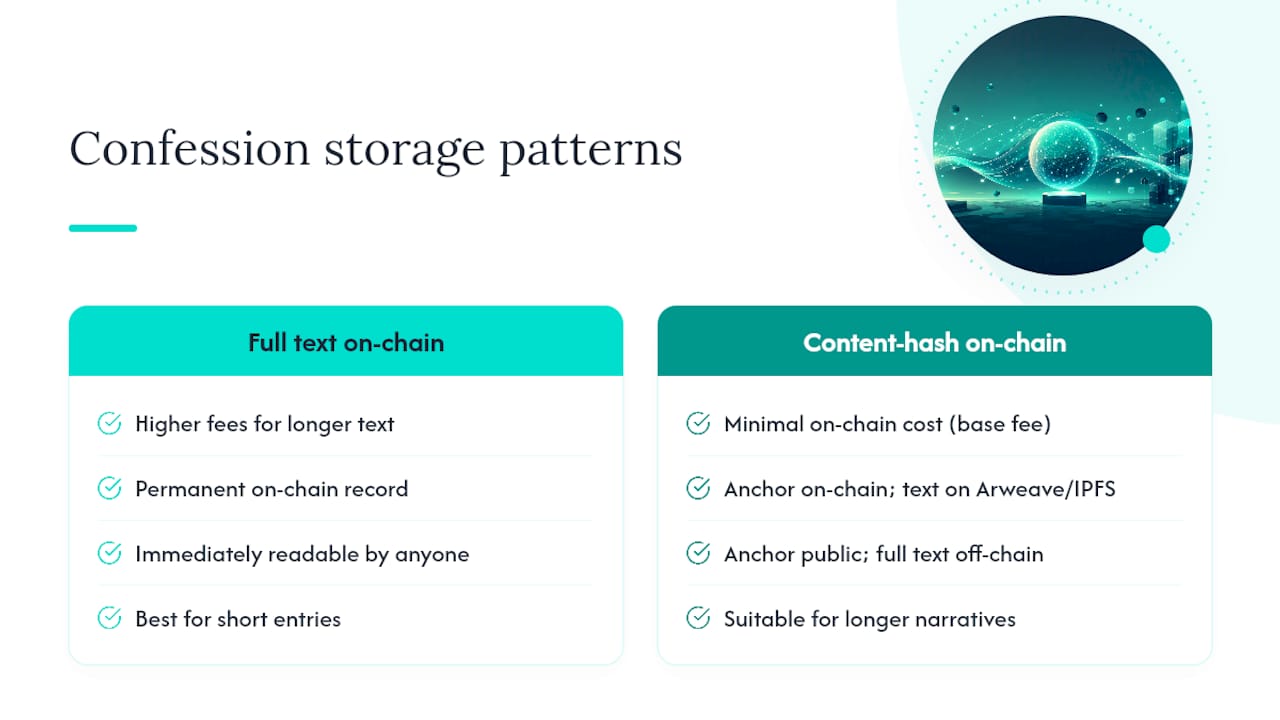
Pattern 2: Content-hash on-chain, full text off-chain A SHA-256 hash of the confession is written on-chain as the anchor. The full text lives on IPFS or Arweave. This is the common production approach for longer narratives because it keeps on-chain costs minimal while preserving verifiable integrity. The trade-off is that off-chain availability depends on pinning services staying online.
Beyond storage, most confession dApps share a common feature set: tipping and reaction contracts, flagging mechanisms, post-fee collection to deter spam, and optional pinning or spotlight mechanics. Research on cryptographic blockchain patterns frames this as the core tension in any confidential on-chain system: on-chain integrity is easy; true confidentiality requires additional layers.
For privacy, the standard practice is strict address compartmentalization. A burner wallet used once and never refunded to your main address is the baseline. Mixing strategies add complexity but not certainty. Blockchain analytics research is clear: reusing addresses across activity gives chain-analysis firms enough signal to deanonymize you. The only reliable mitigation is operational discipline, not cryptographic magic.

For builders who want higher-assurance confidentiality, academic work on evolving committee proactive secret sharing shows what genuine privacy protocols look like. They are not standard for simple confession apps, but they illustrate the ceiling of what is technically possible.
Pro Tip: For confessions longer than a paragraph, use the content-hash approach. Store the full text on Arweave for permanent off-chain availability, anchor the hash on Solana, and your on-chain fee stays near the base transaction cost.
How do you publish a confession on Solana step by step?
You can go from zero to posted in under ten minutes. Here is the exact flow using Confessional.dev.
- Create a fresh Phantom wallet. Download Phantom, generate a new wallet, and write down the seed phrase somewhere offline. This wallet should have no prior transaction history.
- Fund it with a small amount of SOL. You need enough to cover the transaction fee plus any optional pinning cost. Acquire SOL through a method that does not link back to your identity, then send a micro-amount to the burner wallet.
- Connect to Confessional.dev. Go to Confessional and connect your burner Phantom wallet. The UI handles the SPL Memo construction automatically.
- Write your confession. Keep it under the memo size limit for a pure on-chain post, or let the platform handle the content-hash flow for longer text. No account required. No email. No username.
- Sign and submit the transaction. Phantom prompts you to approve. The SPL Memo is embedded in the transaction and broadcast to Solana mainnet.
- Confirm on-chain. Solana's block explorer will show your transaction within seconds. Optionally, pay the additional SOL fee to pin your confession to the King of the Hill spotlight.
Privacy practices to embed into every step:
- Clear your browser cache and cookies before and after the session.
- Use a VPN or Tor to separate your IP address from the transaction timestamp.
- Never send leftover SOL from the burner wallet back to a wallet tied to your identity.
- Do not reuse this wallet for any other transaction.
Caution: once submitted, the confession is irreversible. There is no edit button. There is no delete. Read it twice before you sign.
On tips: Confessional.dev allows other users to tip confessions they connect with. The platform's withdrawal flow is designed to preserve poster pseudonymity, so you can claim tips without linking the withdrawal to your main identity, provided you maintain strict wallet separation throughout.
Pro Tip: Draft your confession in a plain text editor with no cloud sync. Copy it into the UI only when you are ready to sign. This keeps your draft off any server that could be subpoenaed.
What do on-chain posts actually cost, and how permanent are they?
Solana's base transaction fee runs in the range of $0.00025 per transaction at typical network conditions, making a memo-sized confession one of the cheapest permanent records you can create anywhere. Pinning to the King of the Hill spotlight on Confessional.dev carries an additional SOL fee set by the platform, which functions as the competitive bid for the featured position.
Confirmation on Solana is fast. Most transactions reach finality in under a second under normal load, with a practical upper bound of a few seconds during congestion. For the poster, the confession is publicly visible almost immediately.
"Permanent" has two layers worth separating:
- On-chain immutability. The transaction record on Solana's ledger cannot be altered or deleted. This is absolute and cryptographically enforced.
- Off-chain reader availability. If the confession uses the content-hash pattern, the full text on IPFS or Arweave depends on pinning services. An unpinned IPFS file can become unreachable. Arweave's endowment model is designed for long-term persistence, but no off-chain storage is as guaranteed as the on-chain anchor itself.
| Action | Estimated cost | Typical availability |
|---|---|---|
| SPL Memo post (short text, on-chain) | ~$0.00025 in SOL | Seconds to finality |
| Content-hash anchor (on-chain only) | ~$0.00025 in SOL | Seconds to finality |
| IPFS storage (off-chain full text) | Free to low-cost with pinning service | Immediate; depends on pinning |
| Arweave permanent storage (off-chain) | Small AR fee (varies by file size) | Immediate; designed for permanence |
| King of the Hill spotlight pin | Additional SOL fee (platform-set) | Active while bid holds the crown |
The on-chain anchor is forever. The off-chain content is as permanent as you make it.
What are the privacy and legal risks for U.S. users?
Posting can expose you to deanonymization, civil liability, and potential criminal exposure in the United States. Always assume an on-chain confession is discoverable by anyone, including law enforcement and opposing counsel in civil litigation.
Privacy risks:
- Blockchain analytics firms can link wallets through transaction graph analysis, even across burner wallets, if any funding or withdrawal touches a KYC account.
- Metadata leaks: your IP address at the time of submission, browser fingerprint, and timing data can all be subpoenaed from VPN providers or ISPs.
- Reusing a wallet for any other purpose collapses your pseudonymity entirely.
Legal risks in the United States:
- Defamation. A false statement of fact about an identifiable person, posted publicly and permanently, is a textbook defamation claim. The blockchain makes it harder to argue the statement was temporary or limited in reach.
- Self-incrimination. Confessing to criminal conduct on a public ledger is a voluntary statement that prosecutors can use. The Fifth Amendment does not protect you from your own published words.
- Subpoenas and civil discovery. On-chain data is public and requires no subpoena to read. But wallet-to-identity links, VPN logs, and platform access records can all be compelled through legal process.
- Law enforcement preservation requests. Federal agencies can request that platforms preserve records before a formal subpoena arrives.
Consult a U.S. attorney before posting anything that touches ongoing legal matters, identifies another person, or describes conduct that could be criminal.
Safety risks: A confession that reveals enough detail to identify you, or that implicates others, can trigger doxxing or targeted harassment. The public, permanent nature of the ledger amplifies any provocation.
Before you post, ask yourself: if this confession were printed on the front page of a newspaper with your name attached, would you still post it? If the answer is no, either redact all identifying details, convert it to a hashed commitment and store the plaintext off-chain with controlled release conditions, or do not post at all.
Pro Tip: When unsure about legal exposure, write a SHA-256 hash of your confession on-chain as a timestamped commitment. Keep the plaintext off-chain under your control. You prove the words existed at that moment without making them public until you choose to.
Moderation, ethics, and community impact
Censorship-resistance is the point. It is also the problem. Once a confession is on-chain, no platform operator can remove it. The text exists on every archive node that has synced the chain. This is a feature for the poster and a genuine challenge for the community.
Platforms handle this tension without breaking immutability through several practical mechanisms:
- UI-level filtering. The front-end can hide flagged content from the default feed without touching the on-chain record. The data stays; the display changes.
- Economic friction. Requiring a SOL fee to post deters spam and low-effort abuse. Higher fees for spotlight positions concentrate attention on posts people are willing to pay for.
- Community flagging. Users can flag confessions for review. The flag is itself an on-chain or off-chain signal that the UI can act on without censoring the underlying post.
For posters, a short ethical checklist before you sign:
- No false statements of fact about identifiable people (defamation risk, and it is wrong).
- No explicit threats or solicitations.
- No content that could endanger someone's physical safety.
- Assume everything you post will be read by the person you are writing about.
For readers, treat on-chain confessions with skepticism. Anyone can post anything. There is no verification layer. Corroborate before you share, and remember that the permanence of the ledger means a false confession is as durable as a true one.
The ledger does not lie, but you still have to choose wisely
The most common mistake people make with on-chain publishing is treating pseudonymity as anonymity. They are not the same thing. A burner wallet is a pseudonym. It becomes anonymous only if you maintain perfect operational security from the moment you create it to the moment you abandon it. Most people do not. One slip, one refund to a KYC wallet, one VPN that logs your IP, and the pseudonym collapses.
What I find genuinely interesting about Confessional.dev's approach is that it does not pretend otherwise. The platform is built for people who understand the trade-off and choose to post anyway. That is the right framing. Blockchain confessions are not a privacy tool. They are a permanence tool. Use them when permanence is the point, when you want the record to exist regardless of what any platform decides later. Use privacy tools, strict wallet hygiene, and legal counsel when the content carries real risk.
The King of the Hill mechanic is worth noting separately. It turns a solo act of disclosure into a competitive social layer, which is exactly how crypto communities actually work. People do not just want to confess. They want to be seen confessing. The spotlight mechanic captures that honestly.
Confessional makes the Solana confession flow simple
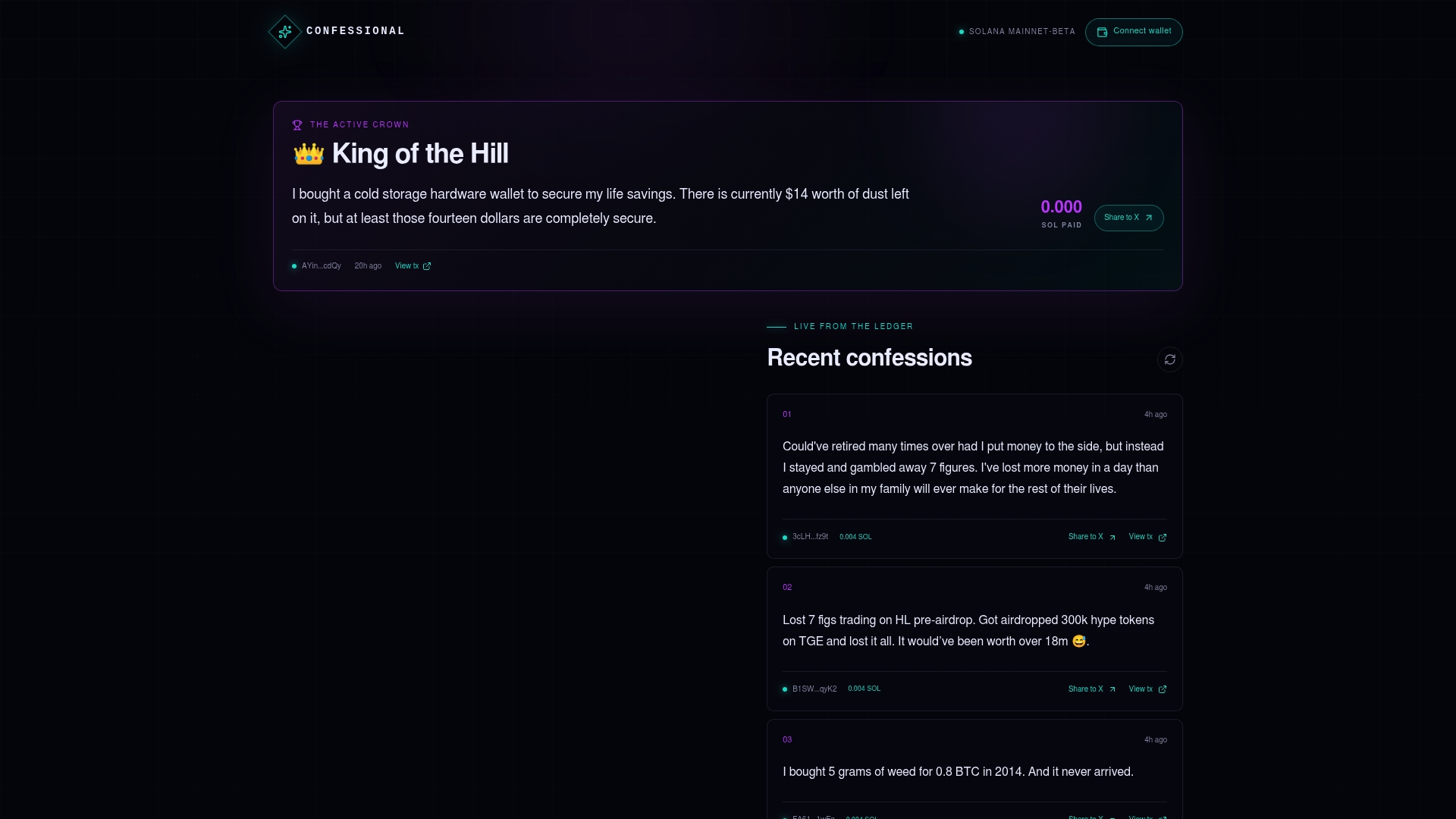
Confessional.dev is a Solana-based publishing platform built specifically for this. Connect a Phantom wallet, write your confession, sign the SPL Memo transaction, and your words are on the ledger in seconds. The platform supports burner-wallet flows natively, requires no account or email, and posts are public, permanent, and permissionless from the moment they confirm.
Key features for this audience: microtransaction posting in SOL, a live on-chain feed showing confessions as they land, anonymity-preserving tip withdrawals so you can collect without linking your identity, and the King of the Hill spotlight for confessions worth pinning. The pricing model is straightforward: a small SOL fee to post, an additional fee to hold the crown.
Ready to etch your confession into the ledger? Confessional and say it once, permanently.
Sources
The sources below back the claims in this article and offer deeper technical or journalistic context for readers who want to go further.
- PrestoAlex/BlockSecrets
- Secrets on the Chain: Cryptographic Blockchain Patterns for Verifiable and Confidential Data Handling
- How an anonymous crypto confession box is revealing investors’ tales of loss and despair | The Independent
- Eprint
- Pew Research Center — 16% of Americans say they have ever invested in, traded, or used cryptocurrency
This article provides general information about on-chain publishing and is not legal advice. For any confession that touches ongoing legal matters, criminal conduct, or identifiable third parties, consult a qualified U.S. attorney before posting.
This article is general information, not a substitute for advice from a qualified lawyer. Consult a qualified legal professional about your own circumstances before acting on anything here.