
Exit liquidity is the pool of buyers that allows a seller to offload a position without collapsing the price. In plain terms: when someone sells, someone else has to buy. The dangerous implication for traders is that you can unknowingly be that buyer, absorbing someone else's exit at an inflated price while they walk away with your money. Classic example: a whale accumulates a token early, hypes it across social media, and sells into the wave of retail buyers rushing in at the top. Those late buyers are the exit liquidity.
Key Takeaways
Exit liquidity is the buy-side demand that lets large holders sell without crashing the price, and recognizing it across crypto and traditional markets is the single most effective way to avoid being the last buyer in a distribution event.
| Point | Details |
|---|---|
| Core definition | Exit liquidity is the buyers who absorb a seller's position; late buyers in hype-driven markets often fill this role at a loss. |
| Top red flags | Thin order books, isolated volume spikes without resting bids, and influencer-driven hype are the strongest warning signals. |
| Defensive tactics | Use limit orders, scale in and out, size positions to available liquidity, and check vesting schedules before buying. |
| Regulatory line | Pump-and-dump, spoofing, and wash trading are illegal under U.S. securities law; report suspected manipulation to the SEC or CFTC. |
| On-chain verification | Wallet analytics tools let you verify what large holders actually did on-chain, independent of what was promoted publicly. |
Table of Contents
- What Is the Exit Liquidity Meaning and How Does It Work?
- How does exit liquidity show up in crypto markets?
- How exit liquidity appears outside of crypto
- What are the warning signs of an exit-liquidity trap?
- How can you avoid becoming exit liquidity?
- When does exit liquidity become illegal in the U.S.?
- What trader confessions reveal about exit liquidity patterns
- The exit liquidity trap is bigger than crypto
- Sources
What Is the Exit Liquidity Meaning and How Does It Work?
Every trade has two sides. For a large holder to sell, there must be enough buy-side demand to absorb the position. Exit liquidity is exactly that demand: the buyers who step in and let sellers out. When the market is deep and organic, this is just normal price discovery. When the demand is manufactured or driven by hype, those buyers are being set up.
The mechanics come down to four structural elements:
- Order-book depth: The total volume of resting buy orders at various price levels. Thin depth means a large sell order will chew through bids fast, causing sharp price drops.
- Market orders vs. limit orders: A market order fills immediately at whatever price is available. In a thin book, a large market sell can move price by 10–30% in seconds. Limit orders give you price control but no fill guarantee.
- Slippage: The gap between the price you expect and the price you actually get. High slippage is a direct signal of poor depth and a warning that large sellers are already moving through the book.
- Spread: The distance between the best bid and best ask. Wide spreads signal low liquidity and high manipulation risk.
- Market impact: A large sell order doesn't just fill at one price; it cascades down through the order book, each tranche filling at a worse price, until the order is complete or the book runs dry. It cascades down through the order book, each tranche filling at a worse price, until the order is complete or the book runs dry.
Picture a staircase of bids descending from $1.00 to $0.60. A whale dropping 500,000 tokens hits the $1.00 bids first, then the $0.95 bids, then $0.90, and so on. By the time the order fills, price has moved significantly. The buyers at each step are exit liquidity for the whale.
Pro Tip: Watch for large resting bids that appear suddenly at round-number price levels during a pump. Organic support builds gradually. Bids that materialize out of nowhere during a hype cycle are often temporary walls placed to slow price decline while insiders sell above them, not genuine demand.
How does exit liquidity show up in crypto markets?
Crypto is where this concept bites hardest. Low regulation, anonymous teams, thin markets, and token designs that concentrate supply in early wallets all create conditions where exit liquidity traps are common. Late buyers in hype-driven assets frequently absorb permanent losses while earlier holders exit at a profit.
The clearest real-world pattern is the pump-and-dump. A team or coordinated group accumulates a low-cap token, drives price up through social media campaigns and fake volume, then sells into the FOMO wave. Retail buyers who chase the move become the exit. Rug pulls follow a similar script: a team launches a token, attracts liquidity into a DEX pool, then removes that liquidity entirely, leaving buyers with worthless tokens and no way out.
On-chain, the warning signs are readable if you know where to look. Large transfers from long-term wallets to centralized exchanges, sudden spikes in DEX pool outflows, and concentrated sell-side offers appearing after a price run are all documented precursors to distribution events. These signals don't guarantee a dump, but they shift the probability sharply.
The exchange type matters too:
| Factor | DEX (e.g., Uniswap, Raydium) | CEX (e.g., Binance, Coinbase) |
|---|---|---|
| Liquidity source | Pooled LP deposits | Market makers and order books |
| Order visibility | No traditional order book; price set by AMM curve | Full order book visible in real time |
| Slippage behavior | Determined by pool depth; can be extreme for small pools | Tighter for high-volume pairs; wider for low-cap listings |
| Manipulation vectors | Liquidity removal, sandwich attacks, pool seeding | Wash trading, spoofing, layering |
| On-chain transparency | Full transaction history publicly visible | Limited; off-chain matching |
DEXs give you more transparency but less protection. A token with $200,000 in pool liquidity can be drained in one transaction. CEXs offer tighter spreads on major pairs but hide the mechanics of market making, making wash trading and spoofing harder to detect.
Tools like Etherscan, Solscan, and Bubblemaps let you trace these patterns without needing a data science background.
How exit liquidity appears outside of crypto
Exit liquidity isn't a crypto invention. It's a structural feature of any market where early holders need buyers to realize gains. The SEC's own guidance on private-company securities makes this explicit: shares in private companies are often illiquid, and common exit events including IPOs, SPAC deals, acquisitions, and liquidation are specifically designed to create the buyer pool that lets early investors out.
In a traditional IPO, venture capitalists and early employees hold shares that are worthless on paper until public buyers arrive. The IPO is the exit liquidity event. Lockup periods post-listing delay insider selling to prevent an immediate dump. But when lockups expire, the supply of shares available to sell increases sharply, and public buyers absorb that pressure. Rule 144 under U.S. securities law governs how and when restricted and control securities can be resold, adding another layer of structured exit management.
SPACs compress this timeline. A SPAC merger can take a company public faster than a traditional IPO, and the disclosure standards have historically been lighter. Critics have pointed out that SPAC sponsors often hold warrants or founder shares that become highly profitable when retail investors buy in, a dynamic that mirrors the crypto exit-liquidity pattern almost exactly.
The Yahoo Finance coverage of SpaceX's private share sales captures the same dynamic in a mainstream context: early stakeholders selling into strong retail demand, with public buyers providing the exit. The difference from crypto is regulation, disclosure requirements, and the presence of lockups. Those guardrails don't eliminate exit liquidity risk, but they slow it down and create legal accountability.
What are the warning signs of an exit-liquidity trap?
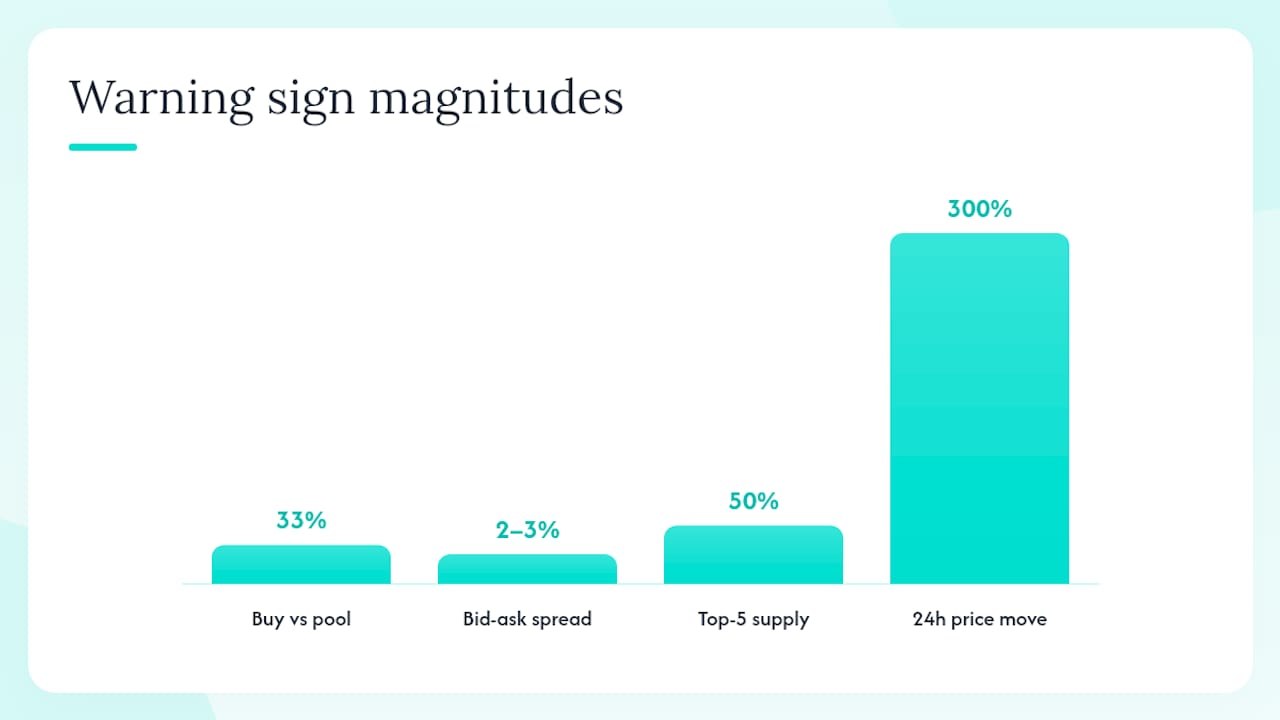
When multiple red flags appear together, the probability that you're being set up as exit liquidity rises sharply. No single signal is definitive, but a cluster of them is a strong reason to pause.
Red flags to check before buying:
- Thin order book or pool: Total visible buy-side depth is small relative to the position you're considering. A $50,000 buy in a $150,000 pool will move price significantly.
- Extremely wide spreads: A bid-ask spread above 2–3% on a token that's supposedly liquid is a structural warning.
- Isolated volume spikes: Volume surges without a corresponding sustained increase in resting bids. Volume without depth is a manipulation signal.
- Influencer-driven hype: Coordinated promotion across Twitter/X, Telegram, and Discord with no substantive project updates. The herd-driven buying that follows is exactly what enables earlier holders to exit.
- Tiny market cap with large price moves: A token with a $2 million market cap moving 300% in 24 hours on thin volume is a classic pump setup.
- Withdrawn DEX liquidity: LP tokens held by the team rather than locked in a time-lock contract. This means liquidity can be removed instantly.
- Wash-trading patterns: Identical buy and sell amounts cycling between a small number of wallets, inflating reported volume without real demand.
- Rapid token lock changes: Vesting schedules that shorten or unlock events that accelerate are a direct signal that insiders want out faster than planned.
Three quick yes/no checks you can run in under two minutes:
- Are the top five wallets holding more than 50% of supply? If yes, concentration risk is high.
- Is there a verifiable LP lock with a time-lock contract address? If no, the pool can be drained at will.
- Does the volume spike coincide with new resting bids in the order book or pool? If no, the volume is likely manufactured.
Social media amplification deserves its own mention. Coordinated pump signals, paid promotions from accounts with large followings, and Telegram groups running "call" campaigns are behavioral red flags as much as technical ones. The hype is the mechanism. It creates the FOMO that drives retail buyers in, and that buying pressure is what the earlier holders need to exit cleanly.
How can you avoid becoming exit liquidity?
There's no perfect defense. But a consistent set of practices cuts your exposure significantly. The goal isn't to eliminate risk; it's to make sure you're not the last buyer in a thinning market.
Use limit orders, not market orders. A market order in a thin book fills at whatever price exists. A limit order gives you price control.
Scale in and scale out. Don't deploy your full position in one transaction. Stagger entries across price levels and time. When exiting, sell in tranches rather than dumping everything at once. This reduces your own market impact and gives you information: if your first tranche moves price significantly, the market is thinner than it looks.
Size down in thin markets. Position sizing should reflect liquidity. That's a self-inflicted exit liquidity problem.
Check vesting schedules before buying. If a token has a large unlock event in the next 30–60 days, early holders have a strong incentive to sell before or during that unlock. On-chain vesting contracts are publicly readable. Use them.
Consider hedges where instruments exist. For larger positions in assets with options markets (Bitcoin, Ethereum), buying puts or using inverse perpetuals can offset downside if you're caught in a distribution event. Most small-cap tokens don't have these instruments, which is itself a reason to size smaller.
Set stop-losses with slippage awareness. A stop-loss in a thin market can trigger and fill far below your target price. Know the slippage you're accepting before you set the order.
In a thin market, each tranche moves price against you. The practical answer is to either accept a worse average exit price or hold longer and hope depth improves, neither of which is comfortable. That discomfort is the cost of entering a thin market without a plan.
When does exit liquidity become illegal in the U.S.?
Aggressive trading is legal. Manipulating markets to create artificial exit liquidity is not. The line is intent and method, and U.S. regulators have been explicit about where it sits.
Pump-and-dump schemes, spoofing, and wash trading are illegal under U.S. securities laws when they're designed to manipulate prices. The SEC enforces these rules under the Securities Exchange Act of 1934, and the CFTC has jurisdiction over commodity markets and derivatives, including certain crypto assets. Both agencies have brought enforcement actions against crypto-specific manipulation.
Clearly illegal behaviors under U.S. law:
- Coordinated pump-and-dump: Buying a security or token, promoting it to inflate price, then selling into the artificial demand. This is securities fraud when the asset qualifies as a security.
- Spoofing: Placing large orders with no intention of filling them to create a false impression of demand or supply, then canceling before execution.
- Wash trading: Simultaneously buying and selling the same asset to generate artificial volume, misleading other traders about real demand.
- Rug pulls tied to securities: When a token qualifies as a security under the Howey Test and the team removes liquidity or abandons the project, this can constitute securities fraud.
If you suspect market manipulation, you can report it to the SEC or the CFTC. Both agencies have whistleblower programs with financial incentives for tips that lead to successful enforcement actions.
One important scope note: U.S. securities laws apply to U.S. persons and entities, and to assets that qualify as securities. Many crypto tokens operate in a regulatory gray zone. That ambiguity doesn't make manipulation legal; it makes enforcement harder. The legal risk for manipulators is real and growing.
What trader confessions reveal about exit liquidity patterns
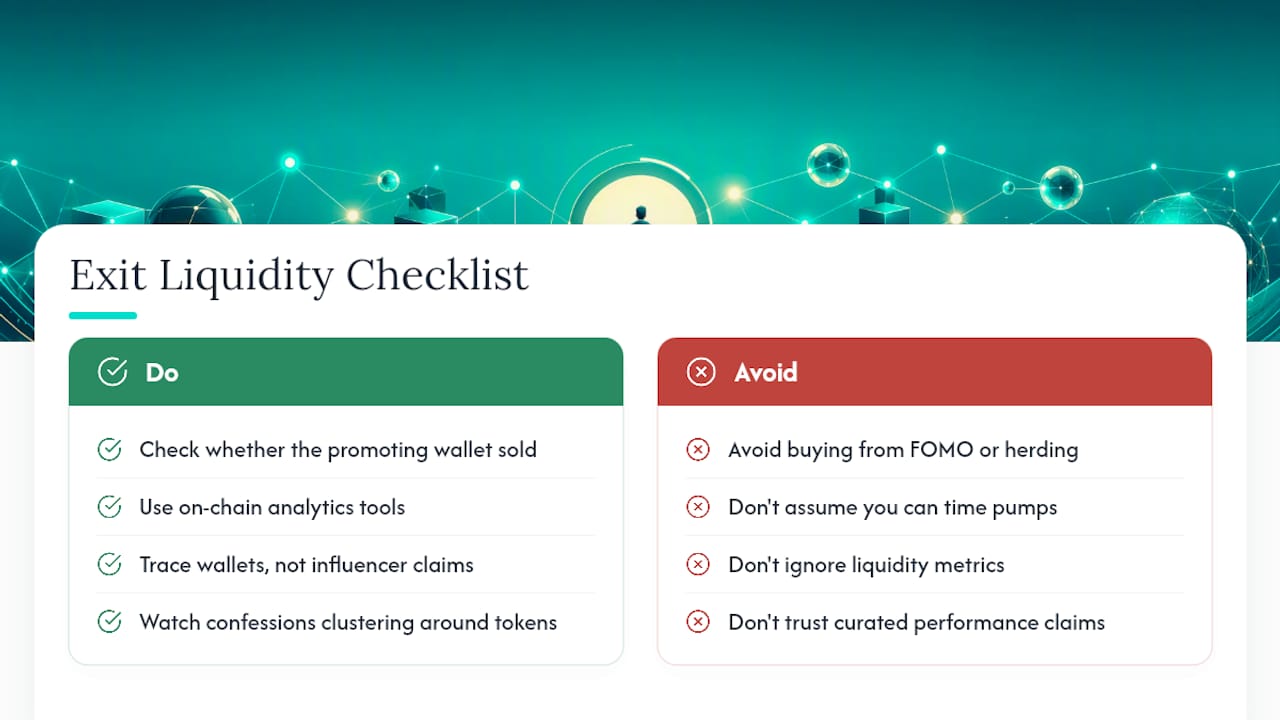
Trader confessions reveal a consistent pattern: FOMO, herding, and ignoring liquidity metrics are the three behaviors that turn ordinary buyers into exit liquidity. The psychology is predictable, and that predictability is exactly what sophisticated sellers exploit.
The behavioral lesson isn't that the trader was foolish. It's that the hype was designed to trigger exactly that response. Social proof, the cognitive shortcut that says "if everyone else is buying, it must be right," is the mechanism. Overconfidence compounds it: the trader who made money on the last pump assumes they can time this one too.
A second pattern involves influencer-driven entries. A trader follows a prominent account that posts a "gem" call with a price target. The trader buys. The influencer, who entered weeks earlier at a fraction of the current price, sells into the attention the post generates. The trader holds, waiting for the target that never arrives. The influencer's audience was the exit liquidity.
These aren't edge cases. They're the dominant mode of retail loss in hype-driven markets, and the cognitive biases driving them (FOMO, social proof, overconfidence, and loss aversion that prevents cutting a losing position) are well-documented in behavioral finance.
Pro Tip: On-chain public feeds and wallet analytics tools like Nansen, Arkham Intelligence, or Solscan let you trace what wallets actually did, not what influencers said they did. Before acting on any call, check whether the promoting wallet sold before or during the announcement. On-chain data doesn't lie.
Platforms like Confessional make this behavioral layer visible in a different way. Traders permanently etch their trade regrets and market takes onto the Solana blockchain, creating a public, uneditable record of what actually happened. That kind of raw, on-chain honesty is rare. It's also one of the most useful signals available: when the confessions of a community start clustering around a specific token or trade pattern, you're looking at real behavioral data, not curated performance.
The exit liquidity trap is bigger than crypto
The conventional framing treats exit liquidity as a crypto-specific scam. That framing is too narrow, and it gives traders in traditional markets a false sense of safety.
Every IPO where insiders sell immediately after lockup expiry is an exit liquidity event. Every SPAC where sponsors hold discounted founder shares while retail investors buy at full price follows the same structure. The difference is that in regulated markets, the rules slow the process down and create disclosure requirements. They don't eliminate the dynamic.
What makes crypto uniquely dangerous isn't the concept. It's the speed, the anonymity, and the absence of the guardrails that traditional markets use to manage the conflict of interest between early holders and late buyers. A lockup period in a traditional IPO gives public buyers time to assess the company before insiders can sell. In crypto, a token can go from launch to rug pull in 72 hours with no legal recourse for buyers.
Understanding exit liquidity meaning across both contexts makes you a better trader in either market. The pattern is the same. The tools to spot it are different. And the cost of ignoring it is identical: you end up holding a bag while someone else holds your money.
Sources
The sources below are prioritized by authority: U.S. regulatory material first, then reputable crypto explainers and on-chain resources. For reporting suspected manipulation, the SEC and CFTC pages are the primary destinations.
- Exit strategies & liquidity | U.S. Securities and Exchange Commission
- What Is Exit Liquidity and How to Protect Yourself | CoinGecko
- What Is Exit Liquidity: Discover Definition, Strategies & More - Coin Bureau
- What Is Exit Liquidity? A 101 Guide | KuCoin
- Crypto
This article is general information, not a substitute for advice from a qualified financial advisor. Consult a qualified financial professional about your own circumstances before acting on anything here.