
Here, "confession prompts" are short, anonymous posts permanently etched onto the Solana blockchain via the SPL Memo program. You sign once, pay a small SOL fee, and your UTF-8 text is immutably logged in the transaction record. No edits. No deletions. Public forever.
The mechanics are simple:
- What it is: A UTF-8 string written to Solana's transaction log through the SPL Memo program, not stored in account state, which keeps costs low.
- What you need: A funded wallet, an RPC endpoint, and your confession text.
- What happens after: The memo is public, indexed by explorers and RPC providers, and searchable by transaction hash or wallet address.
- The cost: A small SOL transaction fee, no rent-exempt deposit required.
Say it once. Keep it forever.
Key Takeaways
Publishing an on-chain confession via the SPL Memo program requires a signed Solana transaction, a UTF-8 memo under the transaction size limit, and a saved transaction signature as your permanent proof of publication.
| Point | Details |
|---|---|
| SPL memos are permanent | Once finalized, memo text in the transaction log cannot be edited or deleted. |
| Confirmation timing | Confirmed arrives in roughly 1–2 seconds; finalized takes approximately 13 seconds. |
| Memos are fully public | Explorers and RPC providers index memo text immediately; anonymity depends on key hygiene, not memo mechanics. |
| Keep memos under 500 bytes | Longer text risks hitting compute unit limits and causing a failed transaction. |
| Confessional simplifies publishing | Confessional handles memo construction, fee processing, finality verification, and live feed indexing automatically. |
Table of Contents
- How do you publish a confession prompt on Solana?
- What does "on-chain forever" actually mean for your confession?
- What privacy and legal risks come with posting on-chain?
- Ready-to-use confession prompts for traders and Web3 users
- Technical pitfalls that kill memos before they land
- How confessional.dev handles this workflow for you
- The moment after you hit send
- Confessional: permanent publishing, no setup required
- Sources
How do you publish a confession prompt on Solana?
Follow this checklist on your first publish attempt:
- Pick a wallet. Phantom, Solflare, and Backpack all support versioned transactions and the Memo program. Fund it with enough SOL to cover the transaction fee.
- Connect to an RPC endpoint. Use a reliable provider (Helius, QuickNode, or the public mainnet endpoint) that supports
getLatestBlockhashand versioned transactions. - Compose your memo. Write your confession in UTF-8, keeping it concise. The Solana Cookbook shows exactly how to create a memo instruction and combine it with a
VersionedTransaction. - Simulate before you send. Run
simulateTransactionto catch errors before spending fees. - Sign and send. Sign with your wallet, then broadcast with your chosen commitment level.
- Wait for confirmation. Watch for
confirmedorfinalizedstatus depending on your use case. - Copy your transaction signature. Save it immediately. It's your permanent receipt and proof of publication.
Pro Tip: Simulate first, always. And for a social market take, confirmed is fast enough. For something you want treated as an archival record, wait for finalized before you claim it's done.
What does "on-chain forever" actually mean for your confession?
Permanence on Solana is real, but it has a specific technical shape worth understanding.
The SPL Memo program logs your UTF-8 string as a program log message inside the transaction record, not as account state. That distinction matters: because no account is created, you avoid rent-exempt deposits entirely, which keeps the cost of publishing a confession to a small base transaction fee. Once the transaction is included in a confirmed or finalized block, that log entry cannot be altered or removed.
The three confirmation levels work like this:
- Processed: The transaction reached an RPC node. Not yet safe to rely on.
- Confirmed: A supermajority of validators voted on the block. Fast, optimistic, and sufficient for most social posts.
- Finalized: The block is locked in and economically irreversible. Use this for anything you're treating as a permanent archival record.
Under normal network conditions, a signed transaction reaches
confirmedin roughly 1–2 seconds andfinalizedin approximately 13 seconds. (Chainflow)
Which level should you wait for?
- Confirmed: Market takes, trade regrets, community posts, anything social.
- Finalized: Timestamped records, legal-adjacent claims, anything you'll reference publicly as permanent proof.
What privacy and legal risks come with posting on-chain?
Anonymity on Solana is about key hygiene, not memo mechanics. The memo text itself is public by design, indexed by every major explorer and RPC provider the moment your transaction confirms. Anyone with your wallet address or transaction hash can read exactly what you wrote.
Concrete risks to know:
- Wallet linkage. If your posting wallet is connected to any on-chain identity (ENS equivalent, NFT holdings, prior transactions), your confession is traceable.
- Explorer indexing. Solscan, SolanaFM, and similar explorers surface memo text immediately after confirmation.
- Third-party archives. Screenshots and off-chain archives can preserve your confession even if the explorer UI changes.
Practical mitigations:
- Generate a fresh ephemeral keypair for each confession session. Fund it with just enough SOL and abandon it after posting.
- Never include personally identifiable information: real names, locations, account numbers, or anything that links the text to your real identity.
- Avoid threats, doxxing, copyrighted material, or content that could constitute illegal speech under US law. This article is general information, not legal advice. Consult a qualified attorney if you're unsure whether specific content crosses a legal line.
Pro Tip: Record your transaction signature the moment to send completes. It's your only guaranteed pointer back to your confession if you're using an ephemeral wallet you'll discard.
Ready-to-use confession prompts for traders and Web3 users
Good on-chain confession prompts are short, pithy, and free of any detail that links back to your real identity. The SPL Memo program validates UTF-8, and Solana transactions cap at roughly 1,232 bytes total, so brevity isn't just style, it's a technical requirement.
A useful inline metadata format: [DATE|CHAIN|TAG] at the start of your memo keeps posts discoverable in feeds without exposing identity. Example: [2026-01|SOL|REGRET].
Short market takes:
[SOL|TAKE] Sold the bottom. Again. The ledger doesn't lie.[SOL|TAKE] Conviction is just cope with a better PR team.[SOL|TAKE] The chart was obvious in hindsight. It always is.
Trade regrets:
[SOL|REGRET] Held through the warning signs because I wrote the thesis. Never again.[SOL|REGRET] Paper hands at $18. Diamond hands at $180. Wrong both times.[SOL|REGRET] Leveraged a rumor. Liquidated on the news. Classic.
Lessons learned:
[SOL|LESSON] Size kills more accounts than bad calls. Respect the position.[SOL|LESSON] The exit matters more than the entry. I know this now.
Cryptic one-liners (maximum anonymity, maximum permanence):
The crown was mine for 48 hours.I knew. I waited. I watched.Signed. Sent. Sealed. No edits.
Keep each memo under 500 bytes of UTF-8 text to stay well inside the transaction size budget and avoid compute unit pressure.
Technical pitfalls that kill memos before they land
Most failed confession transactions come down to a handful of avoidable mistakes.
Blockhash expiry is the most common. A recent blockhash is valid for roughly 150 slots, which is about 60 seconds under normal conditions. If you compose a transaction and wait too long before sending, the blockhash expires and the network rejects it. Always fetch a fresh blockhash immediately before signing and sending.
Inconsistent preflightCommitment causes silent mismatches. Set preflightCommitment to the same level you intend to wait for on confirmation. If you simulate at confirmed but send at processed, you may get unexpected behavior on RPC nodes with different views of the chain state.
- Simulate with
simulateTransactionbefore every send. - Set
preflightCommitment: 'confirmed'for social posts. - Retry with a fresh blockhash if you get a
BlockhashNotFounderror. - Check RPC health before sending; a degraded endpoint drops transactions silently.
Compute budget and memo length interact directly. Very long memos or memos combined with many other instructions can exceed the default compute unit limit and cause the transaction to fail. Keep your confession text concise, ideally under 500 bytes, and add a ComputeBudgetProgram.setComputeUnitLimit instruction if you're bundling multiple instructions.
Durable nonces solve the blockhash expiry problem for advanced workflows. If you want to pre-sign a confession for scheduled posting, offline signing, or a multi-signer flow, durable nonces replace the recent blockhash with a nonce account value that doesn't expire on a slot window.
Pro Tip: After sending, verify your transaction signature on two separate RPC endpoints before declaring finality. One endpoint can lag or fork. Two independent confirmations mean your confession is actually on the ledger.
How confessional.dev handles this workflow for you
Building the memo instruction, managing blockhash freshness, and verifying finality manually is doable. It's also tedious. Confessional handles all of it.
- Wallet-based anonymous publishing. Connect your wallet, type your confession, sign the transaction. Confessional constructs the memo instruction and handles fee plumbing automatically.
- Live on-chain feed. Every confirmed confession appears in a public, real-time feed indexed directly from the Solana ledger. No waiting for an explorer to catch up.
- King of the Hill spotlight. Pay a slightly larger SOL microtransaction to pin your confession to the featured position. Hold the crown as long as no one outbids you.
- Finality verification. The platform polls for
finalizedstatus and surfaces your transaction signature so you can save it immediately. - No account creation. Permissionless by design. Your wallet is your identity, and even that stays pseudonymous.
For traders who want to publish a market take in under 60 seconds without touching a single line of code, Confessional is the direct path.
The moment after you hit send
You compose the memo. Twelve words. A trade regret you've been sitting on for three months. You hit send, watch the spinner, and then the confirmed check appears. Roughly a second, maybe two. You copy the transaction signature and paste it somewhere safe.
That's it. The confession is on the ledger. No one can edit it, including you. There's something clarifying about that finality. Traders publish their market takes and regrets on-chain because the permanence creates accountability that a deleted tweet never could. The ledger doesn't forget. Neither should you.
Confessional: permanent publishing, no setup required
The fastest path from confession to ledger is Confessional. Anonymous, permanent, and processed as a SOL microtransaction with no account required.
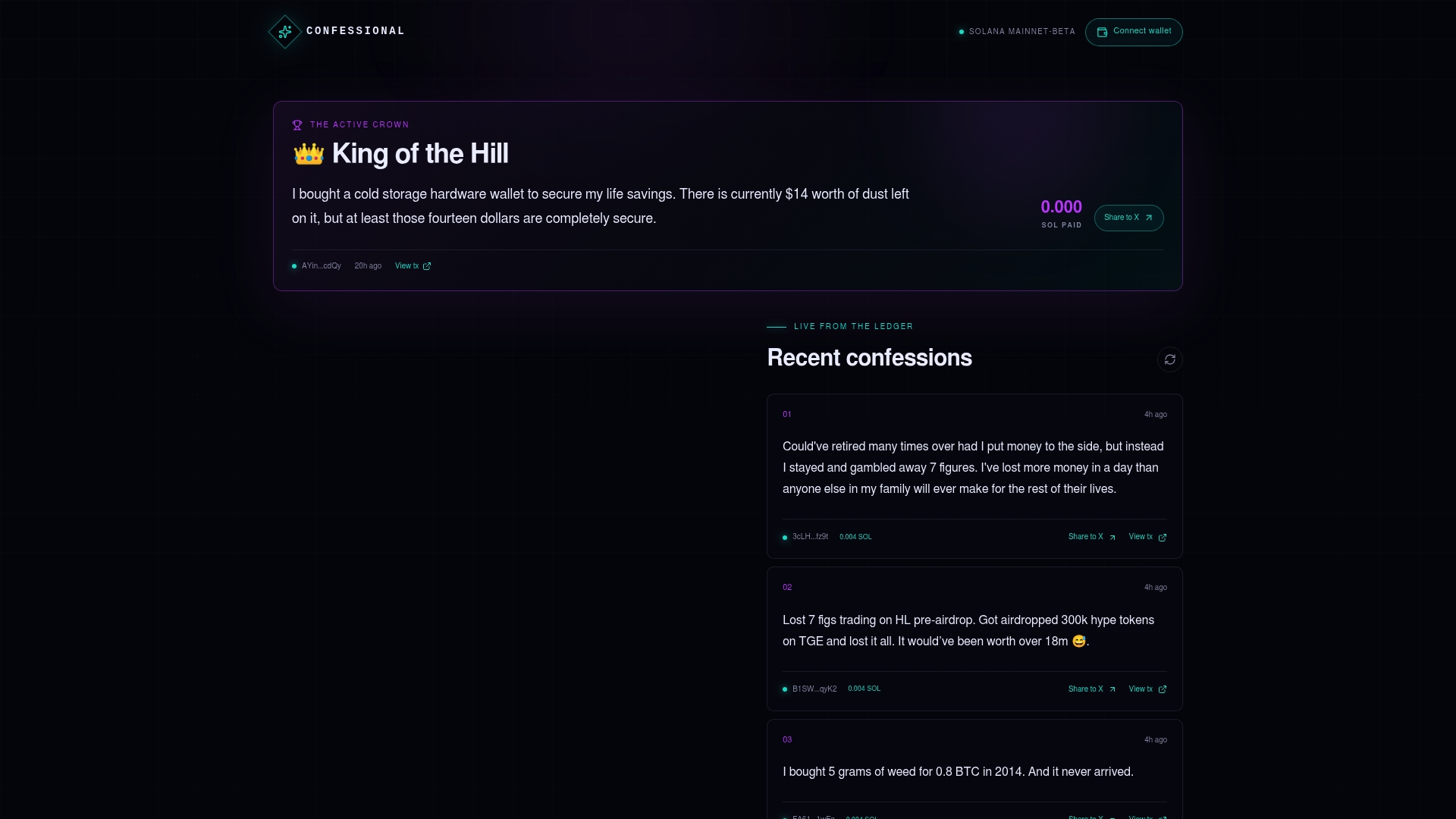
Connect your wallet, write your market take or trade regret, and sign. Confessional builds the SPL memo instruction, manages blockhash freshness, and confirms finality automatically. Your confession hits the live public feed the moment it lands on-chain. Want more visibility? Pay to pin it to the King of the Hill spotlight and hold the crown until someone outbids you. Head to Confessional and publish your first on-chain confession now.
Sources
The sources below back every technical claim in this article. Read the official docs for code samples, current compute limits, and up-to-date RPC API references.
- Lifetime of a Solana Transaction: From Sender to Confirmation
- Solana Cookbook — add memo to a transaction